How to implement low-cost ECG simulation using digital tools?
Low-cost ECG simulation is achieved by projecting dynamic tracings onto a monitor or screen, enabling rhythm recognition and decision-making training without high-fidelity manikins. The instructor uses a computer connected to a projector to display cardiac rhythms, simulating the clinical evolution of a patient under continuous monitoring.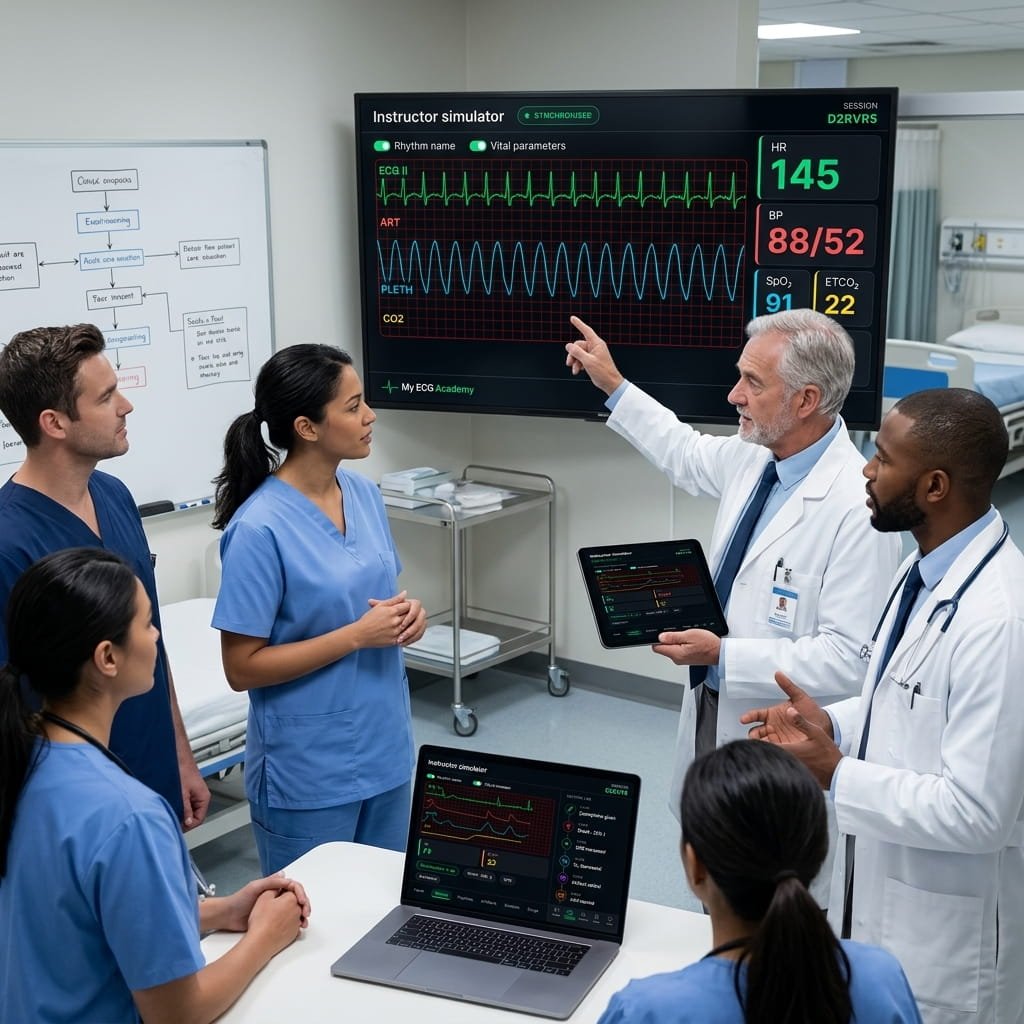
What are the realistic learning objectives for this format?
Focus should remain on electrocardiographic interpretation and intervention prioritisation. Without a manikin, low-cost ECG simulation allows for training in:
- Rapid identification of lethal rhythms and atrioventricular blocks.
- Distinguishing artefacts from genuine pathology.
- Team communication during rhythm transitions.
- Application of Advanced Life Support (ALS) algorithms.
Technical manual skills, such as defibrillation or electrode placement, cannot be trained in this model. The goal is visual literacy and clinical reasoning speed.
Where does screen-based simulation fall short?
The primary limitation is the lack of physical feedback. The trainee does not interact with the chest, cannot palpate pulses, and does not perform compression manoeuvres. Manikin-free training fails to validate the quality of chest compressions or correct pad placement. It is an exercise in reasoning, not manual dexterity.
How to structure an ECG simulation exercise?
Effectiveness depends on the quality of the debriefing. Use the following framework to organise the session:
| Phase | Objective |
|---|---|
| Preparation | Define the initial rhythm and expected clinical change. |
| Execution | Project the ECG and introduce verbal clinical data. |
| Debriefing | Analyse ECG interpretation and therapeutic decision-making. |
Avoid overly complex scenarios. Focus on a single electrocardiographic finding per exercise to ensure the group masters diagnostic criteria before progressing to more subtle rhythms.
Common pitfalls in ECG simulation reading
The most frequent error is interpreting the tracing in isolation, ignoring the clinical context. A wide-complex tachycardia might be ventricular tachycardia or supraventricular tachycardia with bundle branch block. Training must force the student to always ask: "Is the patient stable?" before deciding on the course of action.
Low-cost ECG simulation is a cognitive training tool. Success depends on the instructor's ability to create a controlled-pressure environment, where the monitor reading dictates immediate clinical action.
References
- European Resuscitation Council (ERC) Guidelines
- Manual de Suporte Avançado de Vida
Frequently asked questions
Is it possible to train defibrillation with this method?
No. Low-cost ECG simulation focuses on rhythm interpretation and clinical decision-making. Defibrillation training strictly requires a manikin or a defibrillator simulator capable of energy discharge.
How can simulation be made more realistic?
Introduce verbal clinical data during the exercise, such as blood pressure or level of consciousness. Simulation gains realism when the trainee must integrate the ECG into a critical patient context.
What is the biggest error in ECG training?
The biggest error is focusing solely on QRS complex morphology and forgetting haemodynamic stability. The ECG is a support tool, not a final diagnosis in itself.
This article is training material, not clinical guidance. Management depends on the patient context and on your local protocol. It does not replace certified training or clinical judgement.